5 Stages Of The Vicious Victim Cycle
Ok… I’ll admit it… sometimes pointing the finger elsewhere is WAY easier than dealing with the fallout that comes with ownership. It may be easier however it NEVER creates harmony in relationships.
Never.
Ever.
EVER.
 In the previous post, we identified that victim behaviour includes a number of different evasive tactics including:
- Avoiding responsibility for something or a particular situation through confusion and not knowing
- Indecisiveness
- Outward blaming
Basically it’s always an external factor that’s causing the problem, and again always outside of or beyond the control of the victim. And guess what! As a human being you’re having to deal with outside and external stimulus ALL. THE. TIME! Therefore it stands to reason that the more effective you can become with managing your own style of victim when it’s in action, the better off you are!
With that in mind, I thought it might be helpful to illustrate another sneaky way a victim can show up in your relationships. The following is an example of how the victim cycle and dysfunction can perpetuate itself in real life – YOUR life.
WARNING: This ain’t pretty so hang on to the disclaimer from the last about not judging yourself. Before you can stop the impact victim has is your life, you’ve gotta own that you have a problem in the first place. And I promise, you’ve got a version of victim, we all do, it’s part of the condition of being a human being.
The Vicious Victim Cycle
1. Something happens to upset you, hurt you, or leaves you feeling insecure.
- This can be anything from a clear aggression by someone else – someone saying or doing something with the clear intention of hurting your feelings or making you question yourself or the relationship – to a perceived covert attack like a sideways glance or thinking you’ve been excluded from something.
2. You withhold something. Depending on what happened, when the time comes for you to address the situation, you don’t. It might be that you withhold the information about what you are mad about, or you might withhold communication about something you’ve done that you feel guilty about that affects (or could affect) another person – like maybe you retaliated against the perceived covert attack by talking telling someone else about what they did to you to make them seem like a crappy person or friend.
- Whatever it is, you’re not totally straight about it, you might tell a version of the truth or try to justify why you shouldn’t have to come clean. Regardless, the more important thing here is that you’re not forthcoming with what’s going on for you.
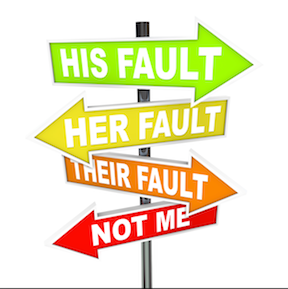 3. You start to judge and criticize in an effort to justify to yourself why you’re in the ‘right’ for not sharing, being open, or taking the risk and being honest about how you’re feeling.
- As soon as you lie about/ pretend/ tolerate/ hide something you automatically judge/ criticize/ ‘make-wrong’ the other person in the exchange.
- ‘Lying about’ means anytime you’re not telling the whole truth, sharing all the relevant information, and lying by omission.
- This can be done in an overt, attacking manner (i.e. verbal fights) or in an passive-aggressive and covert manner (i.e. condescending or patronizing tones, silence, ignoring, exclusion, facial expressions and body language)
4. You start blaming.
- Your judging and criticizing has shifted the blame and responsibility to the other person therefore absolving you of having to own what it was you were doing in the first place.
- This causes the other person to get defensive and react, putting them at step 1 or 2 of this loop.
5. Lather, rinse, and repeat…
Surprised this behaviour denotes VICTIM?
Surprised this is how your victim can show up?
Sadly it’s true. This is a classic example of a dysfunctional cycle, also known as codependency; basically having you cosign for their bullshit OR they’re cosigning for yours….
Ok, yes, this is pretty heavy… and I wanted to make sure you had the full scope of victim behavior. Victims are emotional vampires. They suck the life force out of our spirits and our souls AND we all have tendencies towards this, which means YOU can be an EMOTIONAL VAMPIRE too.
So let’s quickly review…
Victims: we all have a version.
Victims: use evasive tactics to project blame and avoid responsibility.
Victims: toxic emotional vampires and whenever they are present there is no room for functional, harmonious, loving relationships to exist.
Hopefully at this point you’re realizing that part of being a human-being is naturally trying to avoid uncomfortable situations, experiences, and potential conflict. It’s totally normal – because in uncomfortable situations you’re never sure what to expect and we’re WAY more comfortable when we can predict or control an outcome.
Being a victim allows us to push away responsibility for making a change and keep things status quo. Although we may not want things to stay the same, unless we’re willing to get consciously responsible, our affinity for the familiar (a.k.a. our survival mechanisms) will work to keep things the same.
Next week we’re looking at the silver bullet to cure any victim tendencies that may be sabotaging your life. In the mean time, start to notice your victim in action. Good luck!

Until next time ,

How’re You Doing?
I love hearing from my readers! If this was interesting, helpful, or hit home, feel free to leave a comment below or contact me privately!
Stay Informed:
Not yet part of the blog notification list and you want more great articles like this? CLICK HERE get on the weekly mailing list!
Spread The Word:
Don’t hesitate to forward this to a friend or share on your favourite social media platform or forward to a friend by clicking the buttons below! Share the knowledge!
Leave a Reply